Showing posts with label agriculture. Show all posts
Showing posts with label agriculture. Show all posts
Saturday, August 1, 2020
You Don't Have to Be Catholic to be Helped by Nuns
On the passing of John Lewis, the young 1963 Civil Rights leader who went on to represent Georgia in Congress for 33 years, one tribute mentioned nuns who administered a Selma, Alabama, hospital took care of him when he was beaten by police in 1965.
A female Muslim student wrote a prize-winning story about a nun, the principal of a college in Bangladesh, who saw she was absent, visited her family and arranged to help her continue her education after her unemployed father could no longer afford tuition. Shamima Sakendar's story is now a film, "The Soul," which can be viewed on Facebook and YouTube.
Taken together, these mentions of the unheralded contributions religious orders of women reminded me of the legally-trained nuns who represent immigrants in courts at the US border and the recently deceased Sister Carolyn Farrell, who had helped plan, at the invitation of Iowa's governor, the State's long-term goals. She also was elected to the City Council in Dubuque, Iowa, in 1977 and became mayor in 1980, since Council members held that office on a rotating basis.
The work nuns do in Africa is extremely important. To prevent young women from being lured into the human trafficking trade, nuns in Bukoba, Tanzania, help students become self-sufficient in a 3-year sewing program. At graduation, they receive their own sewing machines.
Since 1989, nuns in Kampala Uganda, have provided a home for as many as 30 abandoned babies and children under five at a time. When mothers die in childbirth after traveling long distances to deliver their newborns, relatives often cannot be found to care for the babies. In other cases, women flee from abusive husbands who are left with children they don't want, husbands leave to seek work in cities or abroad and never return and friends and relatives shun women and children who are HIV positive. With help from volunteers, the nuns carry the babies, sleep with them and maintain a cow and chickens to provide milk and eggs to feed them. The nuns try to find caring relatives by posting children's photos in local newspaper ads. If no relatives are found and the children have not been adopted by age 6, they are transferred to a children's home and then a group home until they can support themselves.
As carbon dioxide's greenhouse gases continue to raise the Earth's temperatures, the organic farming practices of nuns in drought-ridden Chilanga, Zambia, provide a valuable example of how to produce a variety of indigenous fruits, cabbage, kale, maize, tomatoes, onions and beans as well as how to raise cows, goats and chickens. By drilling a borehole, the nuns were able to install an irrigation system to spray water over crops. They also use manure as organic fertilizer and crop rotation to keep from depleting soil nutrients. Mixing crops grown on the farm helps control insect damage.
Without becoming Catholic, people around the world benefit from the care nuns provide.

Friday, March 30, 2018
After A Disaster, Give Me A Break
Climate change doesn't let up. Four blizzards hit the East Coast of the United States one after another this winter, and, on the West Coast, mudslides followed the fires that burnt away the trees anchoring soil. People on Caribbean islands, like Haiti, recovered from one hurricane only to be struck by drought and then the wind and torrential rain of another hurricane.
Knowing a hurricane's devastation, or that of a war, and the effort and money needed to repair damage provides motivation for preventive measures. Immense benefit can be gained, if, for example, planting trees goes hand in hand with development, such as China has planned in its One Belt One road Initiative. Consider the benefits of tree projects in Haiti.
A farmer in Haiti, who already had fields planted in potatoes and beans, was working to increase his income by diversifying, when a hurricane hit. His four goats, unable to bear the wind and rain, died of heart attacks. All his potatoes were lost along with at least 80% of his bean crop and what was left of the trees that had been cut down for fuel.
Restoration of trees became a high priority, since they were needed to improve air quality, to stabilize hillsides from washing down over farms, and to provide avocado, mango, and papaya trees for food and income. Fast growing native oaks were needed to provide charcoal for cooking, and cedars and pines were a source of raw material for construction. Reforestation by the Plant With Purpose group's "Cash for Work" program gave immediate income to 2,000 employees.
Long term, a variety of religious groups, the Arbor Day Foundation, and agronomy teams in Haiti have set up nurseries that now plant as many as 60,000 trees per year. Agronomy teams "get down and dirty" with local farmers to start income-producing fruit and other tree nurseries shaded by palm fronds propped up by sticks, to start tree plants in discarded broken buckets, and to employ procedures, such as drip irrigation, composting, and grafting citrus trees. As a result of student hikes to the forests on once barren mountains, from an early age, young people gain an appreciation for their country and learn to value and help plant trees.
Knowing a hurricane's devastation, or that of a war, and the effort and money needed to repair damage provides motivation for preventive measures. Immense benefit can be gained, if, for example, planting trees goes hand in hand with development, such as China has planned in its One Belt One road Initiative. Consider the benefits of tree projects in Haiti.
A farmer in Haiti, who already had fields planted in potatoes and beans, was working to increase his income by diversifying, when a hurricane hit. His four goats, unable to bear the wind and rain, died of heart attacks. All his potatoes were lost along with at least 80% of his bean crop and what was left of the trees that had been cut down for fuel.
Restoration of trees became a high priority, since they were needed to improve air quality, to stabilize hillsides from washing down over farms, and to provide avocado, mango, and papaya trees for food and income. Fast growing native oaks were needed to provide charcoal for cooking, and cedars and pines were a source of raw material for construction. Reforestation by the Plant With Purpose group's "Cash for Work" program gave immediate income to 2,000 employees.
Long term, a variety of religious groups, the Arbor Day Foundation, and agronomy teams in Haiti have set up nurseries that now plant as many as 60,000 trees per year. Agronomy teams "get down and dirty" with local farmers to start income-producing fruit and other tree nurseries shaded by palm fronds propped up by sticks, to start tree plants in discarded broken buckets, and to employ procedures, such as drip irrigation, composting, and grafting citrus trees. As a result of student hikes to the forests on once barren mountains, from an early age, young people gain an appreciation for their country and learn to value and help plant trees.
Saturday, February 4, 2017
Commodity Crush Careers
Commodity traders keep an eye on prices like the following every day.
Per day prices
____________________________________________________________________
Commodities 1/18 1/24 1/31 2/1 2/3
____________________________________________________________________
Cotton 72.3 76.3
Corn 363.5
Coffee 149.5 152.2 149.6 146.8
Cocoa 2229 2202 2091 2063
Rough rice 9.94 9.98 9.54 9.53 9.51
Soybeans 33.83
Sugar 20.95 20.55 20.49 21.3
_______________________________________________________________________________
But commodity traders are not the only ones whose careers involve commodity prices. Whether we live in Toronto or Timbuktu, trading money for goods and bartering goods for goods are what we do all our lives. On the global level there are careers in shipping agricultural commodities that go into what we eat and the mineral commodities that go into what we use. Crude oil is the most traded commodity in the world and coffee is the second.
The prices buyers are willing to sign a contract to pay for commodities roll across the bottom of the CNBC station every trading day. You also can find commodity prices on the internet. I like to check them occasionally to see if there is an up trend or down trend, like the above prices show for cocoa, or up and down volatility.
What each quoted price means is complex. The price quoted for coffee beans applies to 37,500 pounds and the price for sugar applies to 112,000 pounds. These are the amounts that fit in one overseas shipping container. Since a ship might carry 18,000 containers, you can figure how much a company would pay for one shipload of a given amount of pounds.
Commodity prices are also important to those who price consumer goods. In the case of coffee beans, there are the additional costs of roasting the beans, repackaging the 250 bags that carry 37,5000 pounds of coffee on ships into the smaller bags or cans a consumer wants, distributing the coffee to thousands of stores, and advertising a brand.
How to increase prices
When a crop is harvested in countries that produce agricultural commodities, such as coffee, farmers will be offered lower prices if a harvest is large and marketed at one time. If a harvest is smaller because of drought or disease or because it is stored and sold gradually, prices will increase. Countries also can increase coffee export revenue, if they develop roasting facilities. Consequently, there are potential careers in water and pest control, storage, and processing. Some of these same subjects are covered in the earlier posts, "I Love Coffee, I Love Tea" and "Become a Discriminating Chocolate Consumer.")
I
Worldwide booms and recessions are a matter of concern to those whose careers in companies and countries depend on demand for the mineral commodities used in industrial production. Politicians in mineral-rich countries are tempted to take out loans in good times that voters will not want to repay with higher taxes in bad economic times. (The earlier post, "Falling Commodity Prices Spur Diversification in Emerging Markets," lists some of the counties affected by demand for certain mineral commodities.)
Commodities offer a vast field of career opportunities now and probably even more in the future as AI, robotics, and sensors are incorporated. For those interested in investing, the site, investopedia.com, covers the basics and more.
Tuesday, September 27, 2016
Winners and Losers as the Climate Changes
Heat, drought, smog, and car and power plant emissions motivate a search for ways to deal with the climate changes they are causing.
Cosmetic experts, for example, have found plants that purify the skin from pollutants and protect it from sun damage. Moringa seeds from trees that purify water where they grow in Africa and Asia are the secret ingredients in Vichy's Purete Thermale, a cleansing gel that removes pollution's impurities from the skin.
Leila Janah wondered how women in Uganda managed to have lovely, unwrinkled skin despite their country's sun-soaked environment. She discovered their secret was a rare strain of African nilotica shea nuts with an extra concentration of healthy fatty acids that they purchased in a market in Gulu, Uganda. Inspired by this find, she developed a high-end beauty cream line, LXMI, named for the Hindu goddess of beauty and prosperity. Her creams contain not only organic cold-pressed butter from Gulu's shea nuts but also antioxidant fighting Ndali vanilla and Nile-grown hibiscus flowers known to plump and smooth the skin. Perhaps best of all, because LXMI is a high-priced brand that will be sold at Sephora, Janah is able to pay a dignified living wage to the women who harvest the raw materials in her creams.
Drought has launched many a scheme, including an ill-advised one to drag an iceberg south, to provide water for farmers who are said to account for 69% of the water used around the world. Pimpri Sandas in India is among the world's villages that are watering their crops with unfiltered rainwater collected in tanks on billboards designed by Kinetic. Once a tank is full, water sensor technology sends a text message to a mobile phone that alerts a tanker to pick up and deliver the water. In India, Vodafone, owner of the billboards, funds the entire process. Other businesses, such as Hindustan Unilever and Reliance Industries, have constructed dams and ponds to help communities conserve water.
What do frustrated farmers do when their crops die from drought and they go deeper into debt year after year? They move to cities where the UN estimates two-thirds of the world's population will live by 2050. This coming migration emphasizes the importance of the growing urban farming movement which, unfortunately, can produce too little and be too expensive for many displaced farmers. Nevertheless, it is worth examining the option of producing crops closer to where they are consumed. This process reduces pollution from trucking, a health benefit as well as a way to reduce climate warming carbon emissions. And urban farms also absorb rainwater and prevent sewer overflow from polluting rivers and lakes.
City farms can be as simple as outside planter boxes or black pond liners filled with soil. A variety of crops can be planted to determine which are best suited for local conditions, including natural rainfall rather than irrigation. More complicated urban farms rely on greenhouses, earthworms, compost, and recycled water, that is, aquaponics (for more details, see the earlier post, "Exotic Farming."), where filtered water from tanks of edible fish water crops. In some cases, computers monitor water levels, nutrient concentration, and ideal temperatures for different crops.
Overall, efforts to increase yields by planting crops that can withstand changes in traditional heat and rain conditions have not been promising. While cross-breeding created hybrid maize seeds that mature over shorter periods and use water more efficiently, sales are expensive and not widespread. Hybrid seeds have to be purchased each year rather than grown from the seeds of earlier crops, and since fake and falsely labeled seeds have been sold as drought-resistant, the new seeds gained a reputation as unreliable.
Cosmetic experts, for example, have found plants that purify the skin from pollutants and protect it from sun damage. Moringa seeds from trees that purify water where they grow in Africa and Asia are the secret ingredients in Vichy's Purete Thermale, a cleansing gel that removes pollution's impurities from the skin.
Leila Janah wondered how women in Uganda managed to have lovely, unwrinkled skin despite their country's sun-soaked environment. She discovered their secret was a rare strain of African nilotica shea nuts with an extra concentration of healthy fatty acids that they purchased in a market in Gulu, Uganda. Inspired by this find, she developed a high-end beauty cream line, LXMI, named for the Hindu goddess of beauty and prosperity. Her creams contain not only organic cold-pressed butter from Gulu's shea nuts but also antioxidant fighting Ndali vanilla and Nile-grown hibiscus flowers known to plump and smooth the skin. Perhaps best of all, because LXMI is a high-priced brand that will be sold at Sephora, Janah is able to pay a dignified living wage to the women who harvest the raw materials in her creams.
Drought has launched many a scheme, including an ill-advised one to drag an iceberg south, to provide water for farmers who are said to account for 69% of the water used around the world. Pimpri Sandas in India is among the world's villages that are watering their crops with unfiltered rainwater collected in tanks on billboards designed by Kinetic. Once a tank is full, water sensor technology sends a text message to a mobile phone that alerts a tanker to pick up and deliver the water. In India, Vodafone, owner of the billboards, funds the entire process. Other businesses, such as Hindustan Unilever and Reliance Industries, have constructed dams and ponds to help communities conserve water.
What do frustrated farmers do when their crops die from drought and they go deeper into debt year after year? They move to cities where the UN estimates two-thirds of the world's population will live by 2050. This coming migration emphasizes the importance of the growing urban farming movement which, unfortunately, can produce too little and be too expensive for many displaced farmers. Nevertheless, it is worth examining the option of producing crops closer to where they are consumed. This process reduces pollution from trucking, a health benefit as well as a way to reduce climate warming carbon emissions. And urban farms also absorb rainwater and prevent sewer overflow from polluting rivers and lakes.
City farms can be as simple as outside planter boxes or black pond liners filled with soil. A variety of crops can be planted to determine which are best suited for local conditions, including natural rainfall rather than irrigation. More complicated urban farms rely on greenhouses, earthworms, compost, and recycled water, that is, aquaponics (for more details, see the earlier post, "Exotic Farming."), where filtered water from tanks of edible fish water crops. In some cases, computers monitor water levels, nutrient concentration, and ideal temperatures for different crops.
Overall, efforts to increase yields by planting crops that can withstand changes in traditional heat and rain conditions have not been promising. While cross-breeding created hybrid maize seeds that mature over shorter periods and use water more efficiently, sales are expensive and not widespread. Hybrid seeds have to be purchased each year rather than grown from the seeds of earlier crops, and since fake and falsely labeled seeds have been sold as drought-resistant, the new seeds gained a reputation as unreliable.
Thursday, June 2, 2016
Exotic Farming
If Xi Jinping, Kim Jong-un, Vladimir Putin, and Bashar al-Assad suddenly planted vegetable gardens in the front yards of their residences, that would be exotic farming. When she was the US First Lady, Mrs. Obama did encourage young people to eat nutritional vegetables by planting a vegetable garden in the White House's backyard, and she invited students from Wisconsin and other States to help harvest the crops.
Looking around the world you can find other examples of exotic farming. Until late in 2018, Pakistan kept eight buffaloes to provide milk for its prime minister. To grow alfalfa for nearly one million cows, Almarai, the largest dairy producer in oil-rich, water-poor Saudi Arabia, paid $31.8 million for 1,790 acres of land in California. Unfortunately, growing alfalfa there diverted water from the Colorado River that was needed by drought prone California. Transporting heavy, bulky animal feed thousands of miles also required burning fossil fuel that emits the greenhouse gases that cause climate change.
Other examples of exotic farming offer better options. A London warehouse has become an aquaponic vertical farm that grows salad greens and herbs and produces fish. On the roof of a former factory in The Hague, Urban Farmers, a Swiss aquaponics system does the same. Berlin's Infarm modular, indoor hydroponic systems grow herbs, radishes, and greens right in Metro Cash & Carry supermarkets.
Look up aquaponics and hydroponics on the internet. These exotic new urban agricultural projects can be near consumers in shops, restaurants, schools, and hospitals. They can provide job opportunities for those trained to find balconies and roof tops with micro climates that have sun and little wind, to decide what crops to plant, to monitor quality, and to find customers.
Looking around the world you can find other examples of exotic farming. Until late in 2018, Pakistan kept eight buffaloes to provide milk for its prime minister. To grow alfalfa for nearly one million cows, Almarai, the largest dairy producer in oil-rich, water-poor Saudi Arabia, paid $31.8 million for 1,790 acres of land in California. Unfortunately, growing alfalfa there diverted water from the Colorado River that was needed by drought prone California. Transporting heavy, bulky animal feed thousands of miles also required burning fossil fuel that emits the greenhouse gases that cause climate change.
Other examples of exotic farming offer better options. A London warehouse has become an aquaponic vertical farm that grows salad greens and herbs and produces fish. On the roof of a former factory in The Hague, Urban Farmers, a Swiss aquaponics system does the same. Berlin's Infarm modular, indoor hydroponic systems grow herbs, radishes, and greens right in Metro Cash & Carry supermarkets.
Look up aquaponics and hydroponics on the internet. These exotic new urban agricultural projects can be near consumers in shops, restaurants, schools, and hospitals. They can provide job opportunities for those trained to find balconies and roof tops with micro climates that have sun and little wind, to decide what crops to plant, to monitor quality, and to find customers.
Monday, May 9, 2016
1 Invention + 1 Invention = 1 New Invention
Combining two inventions to make a new one has solved a world of problems. Kids need outdoor exercise and water so a South African entrepreneur combined a merry-go-round and pump (See the earlier post, "Hope for the Future.").
There are many reasons to invent a machine to solve the back-breaking problem of planting trees in the hot African sun. Drought-plagued countries, such as Ethiopia and Kenya, need to plant trees along river banks to prevent agricultural soil erosion. New trees also are needed to replace those harvested for firewood and charcoal and eaten by goats. And by sucking carbon dioxide out of the air, trees reduce the greenhouse gases associated with climate change.
The Equinox Community Farm in Wisconsin, USA, has come up with a "water wheel transplanter" it uses to save time and the back breaking work of planting onion seedlings in straight rows. A tractor drags a sort of flatbed trailer that has three large wheels lined with hollow spikes that dig and water holes to ready them for two men who ride on the flatbed and plant pre-grown seedlings. by two men seated on the flatbed. Two 80-gallon tanks leak water out of the spiked wheels that make Could this system be modified to simplify the process of planting trees? After the trees are planted, another pass over the field might put the plastic cones that conserve water over each new tree.
Obviously this is just one idea for creating an invention that can plant the trees Africa needs. There are a wide variety of organizations, government agencies, and companies already looking for solutions: the African Forest Landscape Restoration Initiative (AFR100); World Resources Institute (WRI); government Ministries of Agriculture, Environment, Forest, and Climate Change; Farmers Managed Natural Regeneration; Kenya-based Komaza; the Unique Forestry and Land Use consulting firm; Moringa Partnership.
(Incidentally, by purchasing cards at arborday.org/giveatree, you can plant trees in America's National Forests in honor of family and friends.)
There are many reasons to invent a machine to solve the back-breaking problem of planting trees in the hot African sun. Drought-plagued countries, such as Ethiopia and Kenya, need to plant trees along river banks to prevent agricultural soil erosion. New trees also are needed to replace those harvested for firewood and charcoal and eaten by goats. And by sucking carbon dioxide out of the air, trees reduce the greenhouse gases associated with climate change.
The Equinox Community Farm in Wisconsin, USA, has come up with a "water wheel transplanter" it uses to save time and the back breaking work of planting onion seedlings in straight rows. A tractor drags a sort of flatbed trailer that has three large wheels lined with hollow spikes that dig and water holes to ready them for two men who ride on the flatbed and plant pre-grown seedlings. by two men seated on the flatbed. Two 80-gallon tanks leak water out of the spiked wheels that make Could this system be modified to simplify the process of planting trees? After the trees are planted, another pass over the field might put the plastic cones that conserve water over each new tree.
Obviously this is just one idea for creating an invention that can plant the trees Africa needs. There are a wide variety of organizations, government agencies, and companies already looking for solutions: the African Forest Landscape Restoration Initiative (AFR100); World Resources Institute (WRI); government Ministries of Agriculture, Environment, Forest, and Climate Change; Farmers Managed Natural Regeneration; Kenya-based Komaza; the Unique Forestry and Land Use consulting firm; Moringa Partnership.
(Incidentally, by purchasing cards at arborday.org/giveatree, you can plant trees in America's National Forests in honor of family and friends.)
Sunday, May 1, 2016
Invest in Africa's Agricultural Future
Following the Battle of Waterloo, although Napoleon had been defeated, Baron Rothschild of the 18th century British banking family is said to have observed that the most profit can be made when there is no consensus about the future. His actual quote is believed to have been, "Buy when there's blood in the streets, even if the blood is your own." A potential Disney investor might have said the less gruesome, "Buy when Mickey is still a steamboat captain." When I lived in Hawaii, I often heard the quote, "Missionaries came to do good, and they did very well (financially)."
The point is, now is the time to get in on Africa's future, especially the continent's agricultural potential. It takes time to develop a profitable African connection, and time is on the side of today's young people who have 40 or more years of work ahead of them. One option to explore is the process of putting together a supply chain that buys and brings processed African produce to markets in developed countries. Another is to process, brand, package and bring African products, such as Go Honey, to the growing African market.
Shoppers in Madison, Wisconsin, now buy cassava flour from West Africa at the African & American Store on East Johnson Street. Thanks to Hugh Jackman of Wolverine and musical theatre fame, New Yorkers now drink his Laughing Man Ethiopian coffee at two cafes he opened in Manhattan. A film, "Dukale's Dream," which can be rented at tugg.com/titles/dukales-dream, tells the six-year story of how Jackman and Dukale met and how Dukale's family has prospered. The family that used to spend the day growing coffee and collecting firewood now has a gas system that provides light and a cooking flame. Dukale increased coffee production by buying more land, hiring workers, and training other farmers. His wife owns a small shop and his children attend school.
As a growing continent which now has more than 1 billion mouths to feed, Africa also provides a healthy opportunity for future agricultural sales and profits. The roads and rails China built to move minerals and lumber to ports for export have improved infrastructure for distribution within Africa as well. Countries, such as Nigeria, that have seen falling oil and mineral export prices damage their economies, have been forced to rediscover their agricultural pasts and improve their farm to market road systems.
Director Chris Isaac at the venture capital company, Agdevco, cautions that it can take a 10 to 20 year view to overcome barriers to big returns from African agriculture. He cites competing claims on land that make it difficult to lease or buy. Then, there are poorly educated farmers, poor quality seed and fertilizer, limited access to credit, a lack of infrastructure, an undeveloped marketing network, and a corrupt bureaucracy, especially at the local level. These barriers obviously also impede the progress of women who make up half of Africa's poor farmers. (Also see the earlier post, "Want An Exciting Career?")
What's going on in Uganda suggests the kind of advantageous landscape agricultural investors should seek. Once in the grip of Joseph Kony's Lord Resistance Army (LRA), Uganda is on track to become a rice and maize success story. Millions of dollars of investment have come to the area north of Kampala from international private equity, global venture capital, and private companies, such as German-based Amatheon Agri. What these investors provide are land, high quality seed and fertilizer, leased machinery, training, a market for farmers' output, a grain processing facility, and an integrated value chain for selling grain nationally. Uganda's government has invested in roads and power and has given tax breaks to foreign investors.
With $25, anyone can invest in Africa's agricultural future by going to kiva.org.
The point is, now is the time to get in on Africa's future, especially the continent's agricultural potential. It takes time to develop a profitable African connection, and time is on the side of today's young people who have 40 or more years of work ahead of them. One option to explore is the process of putting together a supply chain that buys and brings processed African produce to markets in developed countries. Another is to process, brand, package and bring African products, such as Go Honey, to the growing African market.
Shoppers in Madison, Wisconsin, now buy cassava flour from West Africa at the African & American Store on East Johnson Street. Thanks to Hugh Jackman of Wolverine and musical theatre fame, New Yorkers now drink his Laughing Man Ethiopian coffee at two cafes he opened in Manhattan. A film, "Dukale's Dream," which can be rented at tugg.com/titles/dukales-dream, tells the six-year story of how Jackman and Dukale met and how Dukale's family has prospered. The family that used to spend the day growing coffee and collecting firewood now has a gas system that provides light and a cooking flame. Dukale increased coffee production by buying more land, hiring workers, and training other farmers. His wife owns a small shop and his children attend school.
As a growing continent which now has more than 1 billion mouths to feed, Africa also provides a healthy opportunity for future agricultural sales and profits. The roads and rails China built to move minerals and lumber to ports for export have improved infrastructure for distribution within Africa as well. Countries, such as Nigeria, that have seen falling oil and mineral export prices damage their economies, have been forced to rediscover their agricultural pasts and improve their farm to market road systems.
Director Chris Isaac at the venture capital company, Agdevco, cautions that it can take a 10 to 20 year view to overcome barriers to big returns from African agriculture. He cites competing claims on land that make it difficult to lease or buy. Then, there are poorly educated farmers, poor quality seed and fertilizer, limited access to credit, a lack of infrastructure, an undeveloped marketing network, and a corrupt bureaucracy, especially at the local level. These barriers obviously also impede the progress of women who make up half of Africa's poor farmers. (Also see the earlier post, "Want An Exciting Career?")
What's going on in Uganda suggests the kind of advantageous landscape agricultural investors should seek. Once in the grip of Joseph Kony's Lord Resistance Army (LRA), Uganda is on track to become a rice and maize success story. Millions of dollars of investment have come to the area north of Kampala from international private equity, global venture capital, and private companies, such as German-based Amatheon Agri. What these investors provide are land, high quality seed and fertilizer, leased machinery, training, a market for farmers' output, a grain processing facility, and an integrated value chain for selling grain nationally. Uganda's government has invested in roads and power and has given tax breaks to foreign investors.
With $25, anyone can invest in Africa's agricultural future by going to kiva.org.
Monday, November 16, 2015
An Army Moves on Its Stomach
 Napoleon was right. Whether its the army of ISIS, the French Foreign Legion, or the US Marine Corps, food fuels military operations. I remember reading about an incident in the US Civil War, when General Lee's army arrived at a supply depot, found it completely empty, and knew the South's cause was doomed. Hunger (and thirst) saps energy and morale.
Countries, causes, and individuals that underestimate agriculture's value are in trouble. Mohsin Hamid describes the misdirected rural to urban rush in his book, How to Get Filthy Rich in Rising Asia. The billion dollars worth of items Alibaba sold on Singles Day are no more able to feed a single person than King Midas' gold. It is a great misfortune that Pakistan, with 180 million people, has only 20% of its GDP devoted to agriculture and that in Nigeria, with 170 million people, agriculture produces only 23% of its $510 billion GDP.
Considering food's importance for everyone, not just armies, agriculture merits the attention of every country's best and brightest. Indeed, modern agriculture is every bit as dependent on skilled techies as fields that now employ digital whiz kids. To help kids discover the challenge of moving food around the world, draw or find a picture of a farmer on the right side of a paper or board and a grocery store on the left side. Start writing down all that needs to happen in between.
What does it take in Uganda, Africa, to go from the gift of a $500 heifer from Heifer International (heifer.org) that produces three gallons of milk a day to the sale, in a local market, of some of the milk the family does not use? Consider all the steps between the woman growing cocoa for the Kuapa Kokoo cooperative in Ghana, Africa, and the retailers selling chocolate bars in Europe. Here are just some possibilities:
- Ask local farmers or Peace Corps volunteers to provide training for raising animals
- Grow feed crops
- Buy disease-resistant seed
- Cool milk
- Buy a truck
- Produce fertilizer from compost to increase crop yields
- Contract shipping space on a cargo ship
- Form a 4H chapter to interest the younger generation in farming
- Pass land use laws to protect small farms from encroachment by corporate plantations
- Lease an acre of land
- Provide police and security measures to protect farmers from gang violence and terrorists
- Build a warehouse to store cocoa beans rather than selling them all at once for a lower price than the revenue that could be earned by selling them over a period of a year
- Install irrigation and water pumps
Nowadays, the "Moo monitors" that dairy farmers attach to their cows' collars produce data about the health of their herds. Machines can pick almost every crop. GPS satellite technology enables farmers to monitor weather, judge the health of their crops, pin point the application of pesticide sprays and fertilizers, spot weeds, and measure yields as crops are being cut. Satellites even monitor the temperature and humidity of produce carried by sea in shipping containers in order to predict its condition for sale on arrival. Thanks to government funding and developers in companies like Planet Labs in San Francisco, which has developed small earth observation satellites that can fit in a shoebox, subsistence farmers will be able to utilize this up-to-date technology.
Already, in countries with impassible roads that subject supplies and produce shipments to long delays, the widespread use of mobile phones enables farmers and fishermen to arrange trades, sales, and payment transfers.
Since we all move on our stomachs, we pray, "Give us this day our daily bread." The world is depending on kids to get involved in producing and distributing the food we all need to live.
Also, check out a few of the earlier posts on food and farming:
Already, in countries with impassible roads that subject supplies and produce shipments to long delays, the widespread use of mobile phones enables farmers and fishermen to arrange trades, sales, and payment transfers.
Since we all move on our stomachs, we pray, "Give us this day our daily bread." The world is depending on kids to get involved in producing and distributing the food we all need to live.
Also, check out a few of the earlier posts on food and farming:
- Can Small Farms End Poverty?
- Nigeria's New Beginning
- World (Food) Expo, Hybrid Crops & New Farming Practices
- Back to the Land
- Dairy Cows on the Moove
- The Bees and the Birds
- Chocolate's Sweet Deals
- Coffee Prices Going Up, Allowances Going Down?
Sunday, September 6, 2015
Can Small Farms End Poverty?
.jpg) Before performers, men, women and young people gather, at the Global Citizen Festival in New York City's Central Park on September 26, for the purpose of ending extreme poverty, let's look at a few of the factors contributing to world hunger. Silo thinking, where everyone focuses on their own problems and solutions, is undermining the need to feed and employ people, provide export revenue from agriculture, and protect the environment.
Before performers, men, women and young people gather, at the Global Citizen Festival in New York City's Central Park on September 26, for the purpose of ending extreme poverty, let's look at a few of the factors contributing to world hunger. Silo thinking, where everyone focuses on their own problems and solutions, is undermining the need to feed and employ people, provide export revenue from agriculture, and protect the environment.Small farms provide employment that prevents a country's rural population from flocking to urban areas that are not ready to provide sufficient jobs, sanitation, housing, transportation, and education. David Hoyle, deputy director of ProForest has pointed out how small farms would benefit from governments willing to engage in land-use planning. What governments need to do is designate specific areas where: 1) villagers can farm and live, 2) concessions are leased to large scale export producers of, for example, palm oil and timber, and 3) forested areas needed to sop up greenhouse gases are protected. Water use planning to prevent pollution and supply sufficient water for sanitation, cooking, and crops is also necessary.
Without land-use planning, plantations governments are counting on to provide agricultural export revenue are in constant competition and conflict with local farmers. Moreover, plantation owners need government help to provide the housing and sanitation facilities, schools, and clinics that are a constant source of complaints by the laborers they employ.
Countries have tried to coordinate local production and crop exports by providing villagers with fertilizer, seeds, technical assistance, and credit. In exchange, under contract state-owned enterprises buy, at fixed prices, what the farmers produce. As earlier posts for Nigeria, coffee, and cocoa reveal, this process has been financially unsuccessful to both governments and small growers. Modifications have led governments to provide farmers with vouchers they can use to buy their own supplies, and private companies or coops have taken over the task of buying commodities from farmers.
Chemical companies in a position to perform research for the precision farming that provides seeds, fertilizer, herbicides, and pesticides adapted to local soil and climate conditions in global areas of extreme poverty now concentrate their efforts on profitable corn, soybean, and cotton crops important to American agriculture, not, for example, cassava, which feeds the poor in sub-Saharan Africa.
Instead of engineering crops to provide added vitamins and minerals to first world consumers, in areas of extreme poverty the same objective could be achieved by introducing small farmers to new crops they could plant and bring to their local markets. Not only would a greater variety of produce improve nutrition, but crop rotation could improve soils and increase a farmer's income. Farmers might save money by controlling weeds with mulch rather than chemicals, and they may even be able to make additional money by using weeds to weave baskets (see baskets for sale at serrv.org) or make bio-fuel.
(Farming topics also are covered in the earlier posts, "World (Food) Expo, Hybrid Crops & New Farming Practices" and "Back to the Land.")
Friday, April 17, 2015
Nigeria's New Beginning
 It was said that General Muhammadu Buhari's election as President of Nigeria on March 31, 2015 was a repudiation of the corruption and cronyism of Goodluck Jonathan's administration. So it was, but it also showed voters are able to overcome the constitutional changes and intimidation that leaders have used to retain their positions and power. Buhari's victory was a profile in persistence, since it took him four tries and 15.4 million votes to be the first candidate to defeat an elected incumbent, since Nigeria became an independent country in 1960. To his credit, Jonathan, who lost with 13.3 million votes, kept his supporters from launching a bloody protest over the election results.
The Buhari-Jonathan presidential race was the latest challenge in Nigeria's troubled political history until Buhari began suffering from an undisclosed illness that has kept him away from his office for long periods of treatment twice in 2017. Nigeria's new tradition of alternating eight-year presidential terms between northern Muslim leaders and southern Christians would be tested if Buhari, a northern Fulani Muslim, were defeated by another northerner who would be eligible for an eight-year term. That would keep southerners out of the presidency for 12 years.
(Richard Bourne's book, Nigeria: A New History of a Turbulent Century, provides a good description of Nigeria since independence.)
Buhari served as Nigeria's military head of state until he was overthrown in a 1985 coup' He was committed to protecting his people from the Boko Haram terrorists who kidnapped nearly 300 teen aged girls and killed thousands of villagers. As Boko Haram was being driven out of Gwoza in the Borno State of northeastern Nigeria, the militant Muslims massacred captured wives and old men. Local citizens expected the group's departure was only temporary. They were right. Just hours after Buhari was sworn in as Nigeria's new President on May 29, 2015, an attack by Boko Haram killed 13 people in Maiduguri, the provincial capital of northeastern Nigeria, before government troops forced the Islamic rebels to retreat. Buhari announced plans to set up a military command center in Maiduguri. Nonetheless, during the Muslim holy period of Ramadan in 2015, over 200 Nigerians were killed. Some 44 people also died in two July 6 bomb attacks in Jos, a city targeted by Boko Haram in the past. In early 2016, only a little over a month after Buhari announced Boko Haram was "technically defeated," the Islamic terrorist group killed 80 people in the village of Dalorl, near Maiduguri. A new abduction of another 100 teen aged girls by Boko Haram occurred in the northeastern Yobe state in February, 2018.
Although Nigeria's oil and natural gas reserves, production, and exports are among the world's best, problems have plagued the industry. To counteract the loss of government revenue from collapsing crude oil prices, in October, 2015 the state-owned Nigerian National Petroleum Corporation announced plans to renegotiate contracts with oil producers in order to get a bigger share of revenue from their deepwater fields. At the same time, oil corporations, also suffering from declining crude prices, are threatening to cut development spending on new deepwater projects in Nigeria. Sagging revenue from falling oil prices is just the latest problem for a government that has faced multiple oil-related challenges: pipeline sabotage resulting in oil spills that have contaminated water, farm land, and air; uncertainty about OPEC's regulations on production; underutilized refinery capacity; lack of capital for deepwater drilling and the infrastructure needed to capture natural gas burn off; and protests by southerners who have never felt they fully participated in the wealth generated by oil fields in the Niger Delta. Bille and Ogale, fishing and farming communities in the Niger Delta, are suing Shell for failing to protect oil pipelines that have caused two oil spills in the past five years. Although Shell agreed to clean up water and land in the contaminated area, the Anglo-Dutch firm has delayed compliance.
Out of Nigeria's 170 million population, 110 million, including college-educated young people, are said to be unemployed. With nothing to do all day and lack of funds, free time leads to pregnancies that produce even more poverty.
The government is committed to re-energizing Nigeria's agricultural sector which was the backbone of the country's economy prior to the 1970s oil boom. The attention Akinwumi Adesina paid to the agricultural sector when he was Minister of Agriculture and Rural Development in Jonathan Goodluck's administration is credited with helping to reduce food imports by a third, to increase food production by 22 million tons, and to generate millions of jobs. By providing electronic vouchers for purchases of fertilizer and seed from private suppliers, the administration worked to move farmers beyond subsistence farming in order to diversify the economy and reduce dependence on oil.
As of May, 2015, Adesina, the son of a Nigerian farmer and PhD degree holder from Purdue University in the US, became the new President of the African Development Bank.
Thursday, December 18, 2014
Chocolate's Sweet Deals
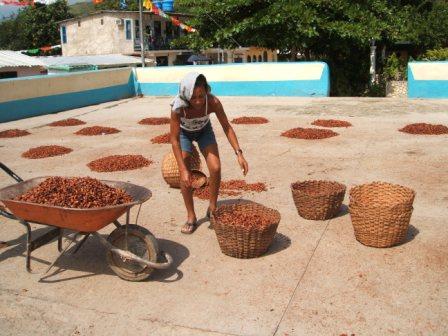 In addition to giving boxes of chocolates as gifts this holiday season, consider giving stocks in cocoa processing plants. But keep an eye on the competition, since the growing demand for chocolate among billions of people in emerging markets, which is expected to increase cocoa processing by 15% in the next ten years, can raise prices on the supply of cocoa beans which has suffered from drought conditions, and it will put a squeeze on profits.
As an example of increased competition, check out how Olam International, headquartered in Singapore, has just become a major competitor with Barry Callebaut AG and Cargill Inc. In addition to shelling out $176 million to a U.S. peanut processor, Olam, which recently purchased the cocoa unit of Archer-Daniels-Midland for $1.3 billion, now has eight cocoa processing plants, including one in the Ivory Coast. The U.S. recently acted to block imports of the UK's Cadbury chocolate which has a higher fat content and creamier taste than Hershey's chocolate. Hershey claimed Cadbury's product names and packaging infringed on their trademark rights and licensing agreements.
Based on projections of a growing demand for chocolate in emerging markets, there is an opportunity for cocoa bean growers in developing countries, by themselves or in conjunction with major processors, to set up their own plants to satisfy local demand. Further, since chocolate can melt when transported in warm weather, local producers have a major incentive to supply emerging markets with locally-produced chocolate products.
The Kuapa Kokoo Cocoa Cooperative in Ghana, Africa, is already a working model of how cocoa growers can benefit by developing a relationship with processors and distributors. Before selling to the cooperative, growers were at the mercy of a state cocoa buying company that did not always pay on time and sometimes cheated when weighing their cocoa beans. Now, the cooperative, working with Divine Chocolate and the fair trade company, SERRV, (serrv.org/divine), participates in the profits generated from the production and marketing of a wide variety of gourmet chocolate bars, chocolate mint thins, Kosher certified milk and dark chocolate coins, and a day-by-day, chocolate heart-filled Advent calendar.
For other ideas of how to make a profit in Africa, see the earlier blog posts, "Never Too Young to Invest in the Future" and "Discover Africa."
Tuesday, May 6, 2014
Back to the Land
.jpg/640px-Fiji0009_(10695134954).jpg) The world needs food. Too many are starving, and too many are unemployed. As summer approaches in the Northern Hemisphere, it is the perfect time for kids to discover the art of farming, not only to feed their families, but also to earn money. Whether at a roadside stand, farmers' market, or open bazaar, there is income to be made by selling vegetables, herbs, fruit, plants, flowers, and seeds. A youth group, for example, grows tomatoes and peppers in a community garden, cooks them, and packages salsa for sale. A bride who wanted her reception to be filled with sunflowers paid neighborhood youngsters to grow them.
The world needs food. Too many are starving, and too many are unemployed. As summer approaches in the Northern Hemisphere, it is the perfect time for kids to discover the art of farming, not only to feed their families, but also to earn money. Whether at a roadside stand, farmers' market, or open bazaar, there is income to be made by selling vegetables, herbs, fruit, plants, flowers, and seeds. A youth group, for example, grows tomatoes and peppers in a community garden, cooks them, and packages salsa for sale. A bride who wanted her reception to be filled with sunflowers paid neighborhood youngsters to grow them.Farming can be simple or sophisticated. There are ready-made kits that include the proper seeds and soils children need for indoor gardens of basil, parsley, thyme, and other herbs that can be used in cooking. These kits come with directions for the amount of light and moisture plants need. Usually plants need 12 to 16 hours of light a day near a window, but strong, prolonged sunlight is harmful. It is a good idea to turn plants around once a week, since they will grow lopsided toward the light otherwise. The best water for plants is tap water that has been left out overnight to reach room temperature and to let some of its chemical content evaporate. Adding eggshells to the water left out overnight enriches the solution.
It also is fun for children to try to grow a plant from plump apple, lemon, orange, or grapefruit seeds that have been washed and dried. Begin by covering the drainage hole in a 4-inch flowerpot with a thin layer of clean small stones and adding about 2 cups of potting soil up to an inch from the top of the pot. (It is possible to remove insects and disease from any outdoor soil by spreading it in a pan, heating it in an oven at 180 degrees for a half hour, and letting it cool.) Lay several seeds of the same fruit on the soil, cover with 1/4-inch of soil, carefully water with room temperature tap water and repeat when needed to keep soil moist, place in a sunny spot, and see if sprouts develop in 3 weeks or longer.
At the end of the earlier post, "A Healthy Environment," there is a detailed description for growing an outdoor garden. According to the National Gardening Association, about 40 million households in the U.S. are growing herbs, vegetables, or fruits, because they want to save money and to raise healthy, organic produce. In an item in the AARP magazine (August/September, 2014), frugal living expert Erin Huffstetler claimed many fruits and nuts are very easy to grow and that there are varieties that suit almost any climate. In particular, she mentiond raspberry, blueberry, and strawberry plants, red seedless grapes, cherry bushes, and almond trees.
In a backyard or community garden, planting a mixture of crops and flowers discourages the pests that like to feast on one particular plant, and using compost cuts down on the need for and cost of using synthetic fertilizer. Using compost, other natural fertilizers and pesticides, mulch, hand-weeding, crop rotation, and earthworms, it is possible to feed the soil, reduce pest infestations, and manage weeds without pesticides, fungicides, herbicides, or other chemicals. (At the end of the earlier blog post, "A Healthy Environment," How Does Your Garden Grow? describes the composting process.) African subsistence farmers even have increased yields by composting and reducing the need for pesticides by growing diverse crops.
Iroquois Valley Farms in Illinois has come up with a way to help farmers, at any age, become organic farmers. Before leasing a conventional farm of at least 80 acres to a tenant, it takes three years for a diverse rotation of crops and earthworms to rebuild soil fertility naturally. After seven years, Iroquois Valley Farms offers the new organic farmer a purchase option.
School projects often lend themselves to farming experiments. Water one part of a garden at night and one during the day to see which plants thrive best. Take a photo of each plot. Supposedly, since less water evaporates at night, that section should look better. Or weed one section and not another. Plants that share water and soil nutrients with weeds should be smaller. Over several years a student could document the effect of rotating crops by planting the same crop over and over every year in one section of a garden and, in other years, alternating that crop with different ones, even flowers, in a nearby section of the same garden. If there are trees on the southern and western sides of a building, see how much cooler the temperature is there compared to the temperature on the other sides of the building.
Experiments with cross-breeding are not new to farmers who have wanted to deter pests, increase yields, and produce crops that tolerate drought, floods, and soil contamination by salt water.The fast growing, high yield rice strain credited with preventing famine in India was the result of cross-breeding a dwarf strain of rice from Taiwan and a taller variety from Indonesia. What is new is the ability to identify the DNA marker or markers in seedlings with desirable genes and to use marker-assisted breeding to produce high yield and other specialized crops. It should be noted, however, that U.S. Department of Agriculture standards do not permit organic farms to use genetically modified hybrid seeds.
Companies, such as Monsanto and DuPont, have profitable seed patents on genetically modified seeds that grow corn, soybeans, and cotton. Before the U.S. pressured Sudan to expel Osama bin Laden in order to purge the country of involvement in al-Qaeda's terrorist attacks, he used to invite visitors to the laboratory where he was developing high quality seeds appropriate for Africa. According to Lawrence Wright's book, The Looming Tower, bin Laden claimed the Dutch had a monopoly on the best banana pods, and he thought Muslims should devote similar diligence to the process of genetically engineering plants.
Whether children live in the city or the suburbs, they can develop an appreciation for how farmers around the world produce the food they eat. An earlier post, "The Bees and the Birds," tells how the pollination process for producing fruits and nuts relies on bees. Why do radio stations like WGN have farm reports telling how much soybeans are selling for? Farmers who know corn is going for $6 a bushel figure the cost of growing a bushel of corn to see if they can make a profit. (An earlier post, "Dairy Cows on the Moove," discusses the costs and income of cows.) Children cannot see the sensors embedded in some fields that monitor when water is needed or the drip irrigation methods other fields use to prevent water loss to wind, runoff, and evaporation. But on a drive in rural areas, they may see the long arms of machines irrigating a dry field. At petting zoos, kids can get up close to goats, and at state and county fairs, they can see prize winning animals and produce. In fall, they might visit a farm for a hay ride or walk through a corn maze.
Away from video games and trash littered highways, in the country, children and adults come face to face with their interrelationship with the natural environment.
Subscribe to:
Posts (Atom)